Layer 1 and Layer 2 on Ethereum: What They Are and Why They Matter
If you've spent any time in the crypto world, you've probably heard the terms "Layer 1" and "Layer 2." They sound technical, but the concept is actually pretty simple — and understanding it will help you trade cheaper and pick the right network.
In this guide we explain what they are, how they differ, and why they matter, using easy-to-follow examples.
The problem that started it all: scalability
Picture a highway running into a city. When traffic is light, everyone moves fast and cheap. But when it fills up with cars, you get traffic jams: everything becomes slow and expensive.
Something similar happens to Ethereum. It's the most widely used smart-contract network in the world, but that popularity creates congestion: when there are lots of transactions at the same time, they become slow and expensive (the famous "gas" fees).
This is what's known as the scalability problem, and it's exactly what Layer 1 and Layer 2 are designed to solve.
What is a Layer 1?
A Layer 1 is the main or base blockchain — the original network where transactions are processed and validated directly.
Ethereum is a Layer 1. So are Bitcoin, Solana, and Tron. They are independent networks, each with its own security and its own consensus mechanism.
Characteristics of a Layer 1
- It's the base network everything else runs on
- It processes and validates transactions directly on its blockchain
- It has its own security and its native token (ETH, in Ethereum's case)
- It's highly secure and decentralized, but it can get congested and expensive
Back to the analogy: a Layer 1 is the main highway. Solid and reliable, but it gets jammed when traffic is heavy.
What is a Layer 2?
A Layer 2 is a network built on top of a Layer 1 (like Ethereum) to make transactions faster and cheaper, without sacrificing the security of the base network.
The idea is simple: instead of processing every transaction on the main highway (and saturating it), Layer 2s process transactions off to the side and then record the result back on the Layer 1. This decongests the base network and lowers costs.
Examples of Layer 2 on Ethereum: Arbitrum and Polygon.
Characteristics of a Layer 2
- It's built on top of a Layer 1 and leans on its security
- It processes transactions faster and more cheaply
- It dramatically reduces fees (gas)
- Ideal for frequent and smaller-value transactions
Following the analogy: Layer 2s are like express lanes or alternate routes that ease the load on the main highway, letting you get there faster and cheaper.
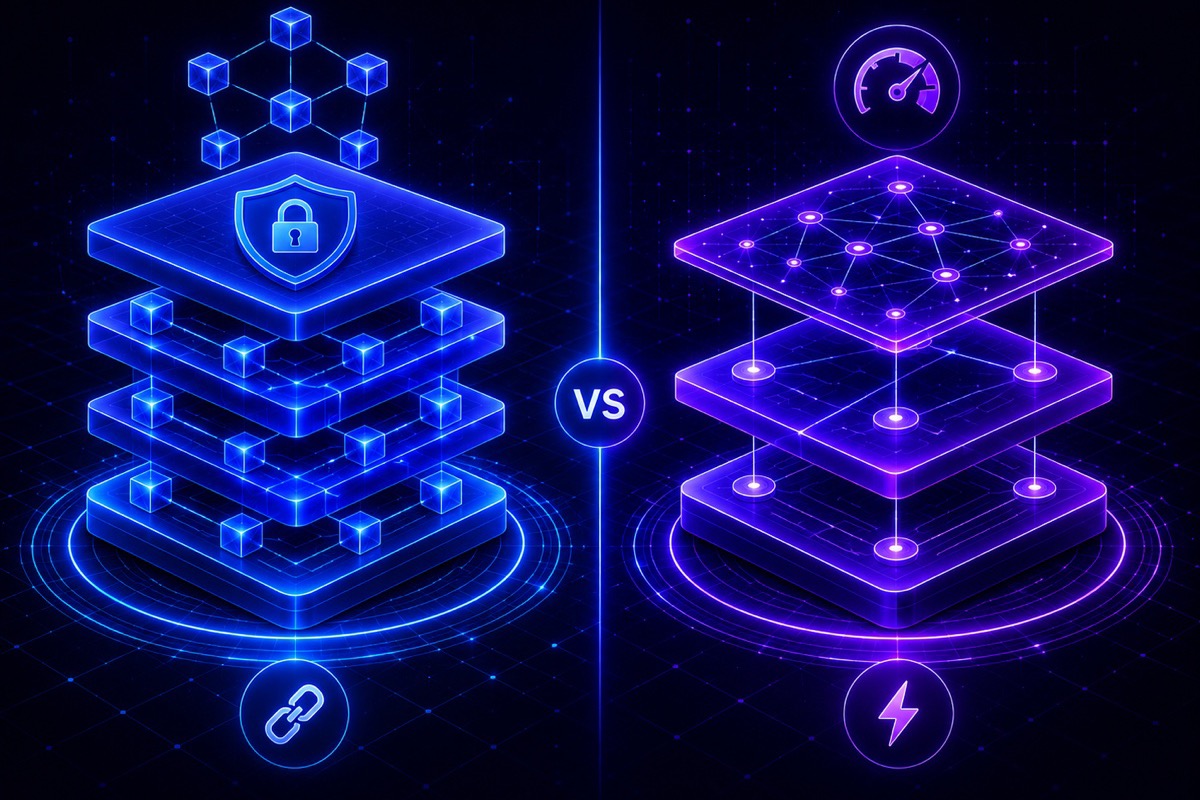
Layer 1 vs Layer 2: a quick comparison
| Characteristic | Layer 1 (e.g. Ethereum) | Layer 2 (e.g. Arbitrum, Polygon) | |----------------|------------------------|----------------------------------| | What it is | Main blockchain | Network built on top of the Layer 1 | | Speed | Slower when congested | Faster | | Fees (gas) | Higher | Much lower | | Security | Its own, maximum | Inherited from the Layer 1 | | Best for | Large transactions, maximum security | Frequent, low-cost transactions |
Why this matters to you
Understanding the difference between Layer 1 and Layer 2 has a direct impact on your wallet:
- If you're making a large transaction and you prioritize maximum security, Layer 1 (Ethereum) may be your choice
- If you make frequent or smaller-value transactions, a Layer 2 (Arbitrum, Polygon) saves you a lot on fees
- Knowing which layer you're operating on helps you pick the most convenient network and avoid overpaying
Layer 1 and Layer 2 on X4T
One of X4T's biggest advantages is that you don't have to pick a single network or juggle multiple wallets. From one single account you can trade on both Layer 1 and Layer 2:
- Ethereum (Layer 1)
- Arbitrum (Layer 2)
- Polygon (Layer 2)
Plus Bitcoin, Solana, Tron, and Binance Smart Chain, all integrated into a single multichain platform.
Thanks to our technology, you can move your assets between networks, always choosing the fastest and cheapest option, without the technical hassle of managing bridges or separate wallets.
Frequently asked questions
Is a Layer 2 less secure than a Layer 1?
Layer 2s inherit much of the security of the Layer 1 they're built on (in this case, Ethereum). That's why they're considered very secure, while also offering the advantage of lower fees and greater speed.
Which is better, Layer 1 or Layer 2?
It depends on your use case. For maximum security on large transactions, Layer 1. For frequent, low-cost transactions, Layer 2. It's not that one is "better" — they're complementary.
Are Arbitrum and Polygon the same thing?
Both are scaling solutions related to Ethereum, but they have their own technologies and characteristics. We'll dive deeper into each one in upcoming articles.
Can I move my funds between Layer 1 and Layer 2 on X4T?
Yes. X4T's multichain technology lets you trade and move assets across different networks from a single account, choosing the most convenient option in each case.
Conclusion: layers that work together
Layer 1 and Layer 2 don't compete — they complement each other. Layer 1 (like Ethereum) provides the security and the foundation; Layer 2s (like Arbitrum and Polygon) provide speed and low cost. Together they make the crypto ecosystem faster, more accessible, and more efficient.
The X4T advantage
- Trade on Layer 1 and Layer 2 from a single account
- Ethereum, Arbitrum, and Polygon integrated (plus Bitcoin, Solana, Tron, and BSC)
- Move assets between networks, choosing the cheapest option
- No technical hassle of bridges or separate wallets
- Institutional security with Fireblocks and VASP regulatory backing
Understanding blockchain layers makes you a smarter user. Trading them the easy way — that's what X4T gives you.
Ready to trade across multiple networks from a single platform? Create your X4T account and discover just how simple the multichain world can be.
Trade Multichain on X4T — Layer 1 and Layer 2 in One Place.